Analytical control: not just for dose banding.
"We only prepare personalised medications, not dose banding. Analytical control does not fit our organisation."
This is a remark we frequently hear in Hospital Pharmacy. It rests on a common misconception: analytical control is exclusively for standardised preparations produced in series. In reality, it is precisely the opposite.
Dose banding and personalisation: two approaches, the same goal
Let’s clarify the terms before going further.
Dose banding | Personalised preparation | |
|---|---|---|
Principle | Standardised doses in bands (e.g., 5-FU 850 mg, 900 mg, 950 mg) | Individual dose for each patient, specifically calculated |
Preparation | Can be anticipated, prepared in batches | Prepared on-demand |
Advantage | Simplifies production, reduces waste | Precisely tailored dosage for the patient |
Risk of concentration error | Present | Higher (each dose is unique) |
Both approaches aim to administer the correct molecule to the patient, at the correct dose, in the correct solvent. Errors in either can lead to grave consequences.
Personalised preparations need more control, not less
The paradox is that Hospital Pharmacies focusing solely on personalised preparations — and believing they lack need for analytical control — are precisely where the risk of error is highest.
1. Each preparation is unique
In dose banding, the technician repeats identical procedures for identical doses. Standardisation reduces cognitive load. In pure personalised preparation, each bag has its distinct concentration. The technician transitions from one calculation to another, from one volume to another, from one solvent to another. The cognitive load is maximal.
2. Individualised calculations multiply failure points
Body surface, renal function adjustment, dose reduction for toxicity, rounding... Every calculation step offers an opportunity for error, which are visually challenging to detect: a 5-FU bag at 920 mg and one at 820 mg look precisely identical to the naked eye.
3. Double visual checks miss nearly half of errors
A study at Geneva University Hospitals (Carrez et al., 2017, J Oncol Pharm Pract) measured the actual effectiveness of double visual checks on chemotherapy preparations. The results speak for themselves:
Of 7 errors made, only 4 were detected — 3 went unnoticed (failure rate of 43%)
40% of preparations showed a deviation of more than 5% from the target dose
The double visual checkhad no measurable impact on dose accuracy
Almost half of errors slip through the net — not due to negligence, but because the human eye cannot distinguish between two close concentrations in a transparent bag. It is not about team competence. It is a physiological limit.
What the Good Preparation Practices 2023 say
The Good Preparation Practices 2023, published by Swissmedic, advocate the use of analytical technologies in end-product verification strategy, whenever risk assessment justifies it. For cytotoxic preparations, risk assessment consistently justifies it.
The Good Preparation Practices make no distinction between dose banding and personalisation. Analytical control is not an option reserved for large centres practising dose banding. It is a recommendation for every Hospital Pharmacy whose risk assessment identifies a need for enhanced control — which includes chemotherapy preparations.
Control methods in real-world applications
Each method has strengths — and blind spots.
Method | Strengths | Limits |
|---|---|---|
Double visual check | Simple, integrated into workflow | Detects only 57% of errors (Carrez et al., 2017). No impact on dose accuracy |
HPLC | Highly accurate | 20-30 minutes per analysis. Requires qualified personnel and dedicated laboratory. Incompatible with release flow |
Video control | Visual traceability | Does not guarantee final product conformity. Cannot always distinguish air bubbles from double extraction |
Gravimetric control | Detects volume errors | Does not confirm molecule identity. Limited precision for small volumes |
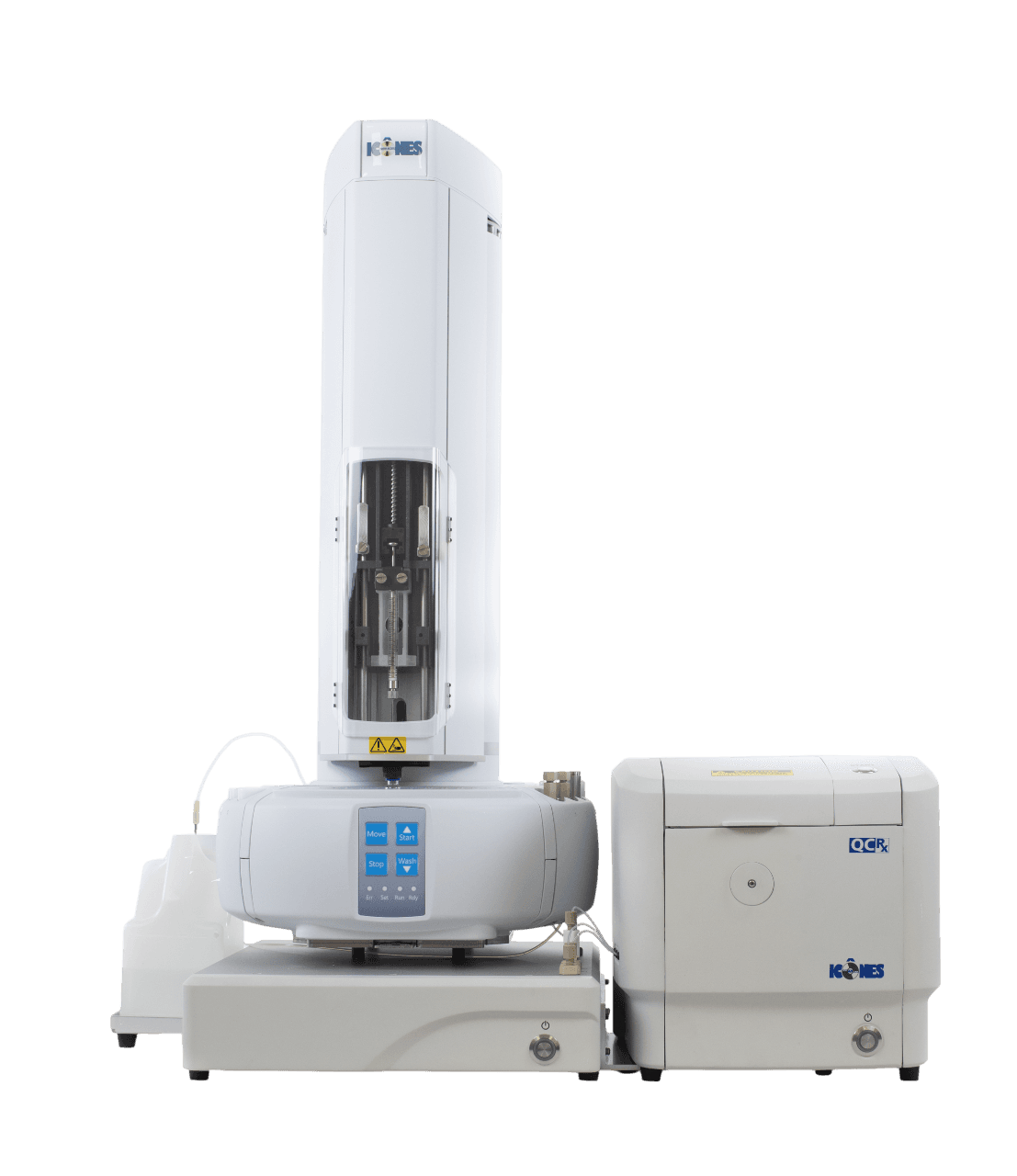
Analytical control (QCRx) | Verifies molecule + concentration + solvent in 70 seconds | Requires system acquisition |
The observation: none of the first four methods alone certifies that the finished product contains the correct molecule, at the correct dose, in the correct solvent — in real time.
The QCRx: same solution for dose banding and personalisation
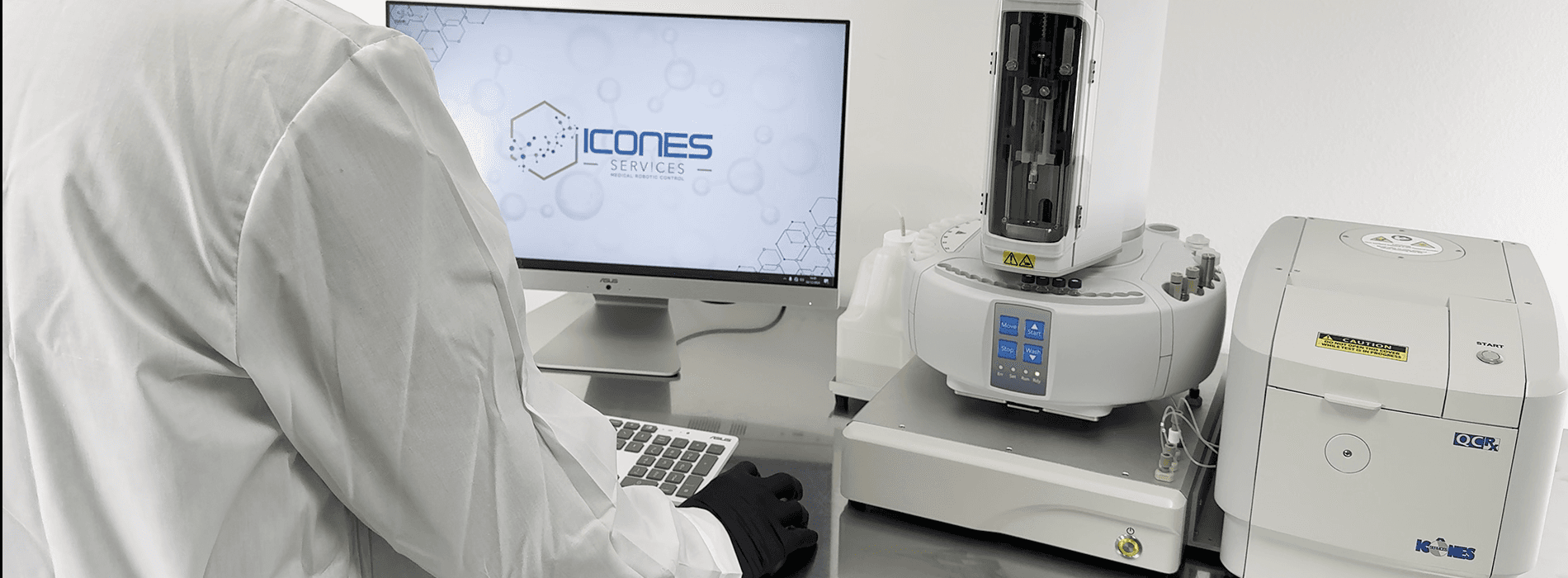
The QCRx analyses each bag individually using UV-visible and Raman spectrophotometry. It does not compare to a batch standard: it directly measures the contents of the bag.
Whether you prepare 50 identical bags of 5-FU in dose banding or 50 personalised bags with different concentrations, the QCRx checks each one in 70 seconds:
Molecule: is it truly 5-FU and not carboplatin?
Concentration: is the dose in line with the prescription?
Solvent: NaCl 0.9% or glucose 5% — is it the correct one?
The result is automatically archived. The traceability is complete. And release happens in real time, without slowing down the preparation flow.
Misconceptions vs reality
What is heard | The reality |
|---|---|
"Analytical control is for dose banding" | The Good Preparation Practices 2023 encourage the use of analytical technologies whenever risk assessment justifies it — without distinction between dose banding and personalised preparation |
"Pure personalisation, double checking is enough" | It detects only 57% of dose errors (Carrez et al., 2017) |
"Our doses are personalised, therefore more precise" | Personalisation increases complexity and risk of error |
"The QCRx is not suitable for our organisation" | It analyses each bag individually, regardless of dosage |
"It's too slow for our flow" | 70 seconds per bag, integrated into existing flow |
In summary
Analytical control is not a luxury reserved for centres practising dose banding. It is a safety barrier that makes complete sense when each bag is unique — precisely in personalised preparation.
The Good Preparation Practices 2023 advocate the use of analytical technologies. The study by Carrez et al. (2017) confirms it. And QCRx makes it feasible on a daily basis, without disrupting your organisation.
Do you strictly perform personalised preparation? That's precisely why analytical control is designed for you.
Stay connected:
Subscribe to our newsletter
Receive our offers and explore the current products