Monitoring Chemotherapy Preparations: balancing Regulatory Requirements and Practical Realities

Monitoring Chemotherapy Preparations: balancing Regulatory Requirements and Practical Realities

Oversight of Chemotherapy Preparations: Balancing Regulatory Demands with Practical Realities

Every day, thousands of chemotherapy bags are prepared in pharmacy units throughout France. Each one must contain the correct molecule, at the right concentration, and in the appropriate solvent.

The acceptable margin for error? Zero.

Nevertheless, teams work under pressure: activity peaks, staff turnover, and reduced numbers. Even the most meticulous visual double-check cannot catch everything.

Every day, thousands of chemotherapy bags are prepared in pharmacy units throughout France. Each one must contain the correct molecule, at the right concentration, and in the appropriate solvent.

The acceptable margin for error? Zero.

Nevertheless, teams work under pressure: activity peaks, staff turnover, and reduced numbers. Even the most meticulous visual double-check cannot catch everything.

Pharmacien qui prépare une poche pour contrôle qualité pharmaceutique hospitalier

Visual double-checking alone is insufficient.
Research confirms this.

One might assume that two pairs of eyes are better than one. In reality, it is more nuanced.

A study conducted at the Geneva University Hospitals assessed the actual effectiveness of double visual checks on chemotherapy preparations. The results are unequivocal: the double check detected only 4 errors out of the 7 that occurred, meaning 3 errors slipped through the net.

Even more concerning: 40% of preparations had a deviation greater than 5% from the target dose. The double visual check had no impact on this accuracy.

Préparateur en pharmacie qui prépare une poche pour contrôle

This is not a matter of competence.

It's a human limitation, intensified by:

Fatigue

Several studies associate professional burnout with an increase in medication errors.² A recent meta-analysis suggests that one in two pharmacists may be affected by burnout.³

Fatigue

Several studies associate professional burnout with an increase in medication errors.² A recent meta-analysis suggests that one in two pharmacists may be affected by burnout.³

Staff turnover

Training a new pharmacy technician takes time, and staffing levels can vary. The SFPO guidelines recommend that at least 50% of the team should be experienced personnel.

Staff turnover

Training a new pharmacy technician takes time, and staffing levels can vary. The SFPO guidelines recommend that at least 50% of the team should be experienced personnel.

Time constraints pressure

The medical green light initiates a countdown. Ideally, patient waiting time should not exceed one hour following medical approval (SFPO Recommendation No. 12).

Time constraints pressure

The medical green light initiates a countdown. Ideally, patient waiting time should not exceed one hour following medical approval (SFPO Recommendation No. 12).

Cognitive load

Preparation periods should not exceed 2 continuous hours in order to maintain alertness (SFPO Recommendation No. 10).

Cognitive load

Preparation periods should not exceed 2 continuous hours in order to maintain alertness (SFPO Recommendation No. 10).

However, human error is not a fault. It is a factor to be integrated within the quality system.

The 2023 GMP guidelines are clear: final product control is now mandatory.

The 2023 Good Preparation Practices enhance the requirements for release control. Chapter 6 states that the finished product must be tested before the release of each batch, with full traceability.

The SFPO recommendations for oncological pharmacy go even further:

Analytical monitoring advised for high-risk preparations

Annual qualification of equipment by external service provider

Archiving and traceability at every stage of preparation

Key point

The GPP 2023 specify that 'the release control relies as much as possible on new gravimetric, analytical, or digital technologies,' regardless of the type of preparation.

Dual Verification, HPLC, Video
Each Method Has Its Blind Spots

Dual visual inspection

Benefits

Streamlined and seamlessly integrated

Restrictions

Does not detect all errors (67% failure rate in the HUG study¹). No impact on dose accuracy.

HPLC

Benefits

Highly precise

Restrictions

20-30 minutes per analysis⁵. Requires qualified personnel and a dedicated laboratory. Not compatible with the release workflow.

Video surveillance

Benefits

Visual traceability

Restrictions

Does not ensure final product compliance. Not suitable for dose-banding control.

Gravimetric Control

Benefits

Identify volume discrepancies

Restrictions

Does not confirm the identity of the molecule. Limited precision for small volumes

Dual visual inspection

Benefits

Streamlined and seamlessly integrated

Restrictions

Does not detect all errors (67% failure rate in the HUG study¹). No impact on dose accuracy.

Video surveillance

Benefits

Visual traceability

Restrictions

Does not ensure final product compliance. Not suitable for dose-banding control.

HPLC

Benefits

Highly precise

Restrictions

20-30 minutes per analysis⁵. Requires qualified personnel and a dedicated laboratory. Not compatible with the release workflow.

Gravimetric Control

Benefits

Identify volume discrepancies

Restrictions

Does not confirm the identity of the molecule. Limited precision for small volumes

The assessment

None of these methods alone can certify that the finished product contains the correct molecule, at the correct dosage, in the right solvent — in real-time.

Final Product Analytical Review:
Focusing on What Truly Matters

What if, instead of controlling the process, we directly control the outcome?

This is the principle of release analytical control on the finished product:

01

Minimum sample (~1 ml) from the finished bag

02

Spectroscopic analysis (UV + Raman) in seconds

03

Accurate identification of the compound, its concentration, and the solvent

04

Immediate release if compliant, alert in case of discrepancy

01

Minimum sample (~1 ml) from the finished bag

02

Spectroscopic analysis (UV + Raman) in seconds

03

Accurate identification of the compound, its concentration, and the solvent

04

Immediate release if compliant, alert in case of discrepancy

This approach introduces a clear final safeguard, independent of human fatigue or attention.

Dose banding or compounded preparations:
same need for control

"We only carry out master preparations, not dose banding."

This is an observation we occasionally come across. It stems from the misconception that analytical control is exclusively for pre-prepared standard doses. The reality is quite the opposite.

Two approaches, one shared safety challenge

Definition

Definition

Compounding

Compounding

Molecular error risk

Molecular error risk

Risk of concentration error

Risk of concentration error

Standard procedure impact

Standard procedure impact

BPP Requirement 2023

BPP Requirement 2023

Risk of concentration error

Risk of concentration error

QCRx® adapted

QCRx® adapted

Dosing standardisation

Standardized doses in bands (±5-10% of the theoretical dose)

Standardized doses in bands (±5-10% of the theoretical dose)

May be anticipated, in batches

May be anticipated, in batches

Available

Available

Available

Available

Standardized Fixed Doses

Standardized Fixed Doses

Yes (repetition of the same doses)

Yes (repetition of the same doses)

Recommended release control

Recommended release control

Yes

Yes

Specialised formulary preparation

Specialised formulary preparation

Individualized dosage for each patient, calculated based on body surface area

Individualized dosage for each patient, calculated based on body surface area

Prepared extemporaneously upon request

Prepared extemporaneously upon request

Available

Available

Higher (per individual dose)

Higher (per individual dose)

Higher (individual calculations)

Higher (individual calculations)

No (consistent variability)

No (consistent variability)

Recommended release control

Recommended release control

Yes

Yes

Why Compounded Medicines Require Extensive (or Even Greater) Control

One

One

Each preparation is a distinct case

In dose banding, the technician consistently performs the same steps for identical doses. This routine fosters procedural consistency. However, in precise compounding, every bag requires its unique concentration, such as 127 mg, 89 mg, 203 mg, and so forth. This scenario involves peak cognitive load, which inherently raises the risk of error.

Two

Two

Tailored calculations increase the number of potential failure points.

Body surface area, adjustment according to renal function, dose reduction... Each calculation presents an opportunity for error. Analytical control validates the final result, regardless of the complexity of the initial calculations.

Controlled

Controlled

The double visual check is even less reliable with atypical doses.

The French simulation study (Bonabry et al., 2016) indicates that visual double-checking identifies only 57% of dosing errors. When dealing with 'round' and repetitive figures, the eye might notice aberrations. Comparing against 127.4 mg vs 174.2 mg? Far less likely.

4

4

The 2023 BPP guidelines make no distinctions.

The message is clear: release control must rely on analytical technologies for all preparations, not just standardised hospital preparations.

Overview:
Common myths vs reality

Preconceived notion

"Analytical control is for dose banding"

"Analytical control is for dose banding"

"In pure compounding, double verification is adequate"

"In pure compounding, double verification is adequate"

"Our dosages are customised for greater precision."

"Our dosages are customised for greater precision."

"QCRx® is not suited to our organisation"

"QCRx® is not suited to our organisation"

Reality

Reality

The 2023 BPP advises it for ALL preparations

The 2023 BPP advises it for ALL preparations

It identifies only 57% of dosage errors

It identifies only 57% of dosage errors

Customization increases complexity and the risk of error

Customization increases complexity and the risk of error

He evaluates each bag individually, regardless of the dosage

He evaluates each bag individually, regardless of the dosage

Analytical control designed for the daily operations of hospital pharmacies

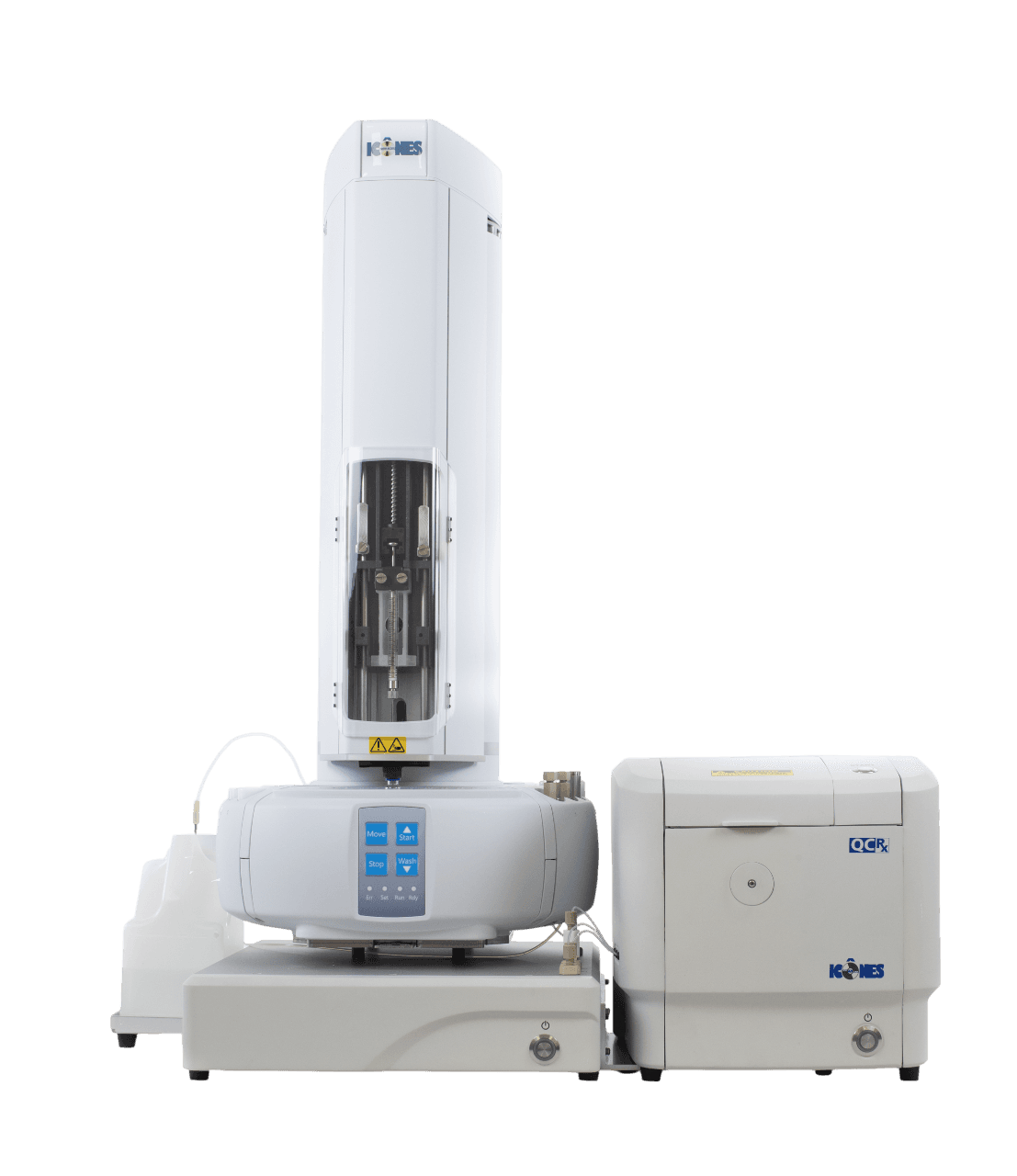
QCRx® has been developed in collaboration with hospital pharmacists to solve a simple equation: better control, without slowing down.

What QCRx® does:

Verify the solvent used

Verify the solvent used

Automatically archive each assessment

Automatically archive each assessment

Releases or alerts in under 70 seconds

Releases or alerts in under 70 seconds

Accurately measure the concentration

Accurately measure the concentration

Accurately measure the concentration

Identifies the compound using UV and Raman spectroscopy

Identifies the compound using UV and Raman spectroscopy

Impact on daily operations:

Prior

Prior

Dual visual inspection (67% undetected errors¹)

Uncertainty regarding the actual concentration

Time spent on video review

Manual traceability

Using QCRx®

Using QCRx®

Objective analytical assessment

Assurance on content

Real-time release

Automated Archiving

What it doesn't require:

No dedicated laboratory

No costly consumables

No specific analytical training (just ours)

No deceleration of the production flow

Whether it's dose banding or compounding: the result remains consistent! Whether you're preparing 50 identical bags of 5-FU in a dose banding or 50 customised bags with varying concentrations, the QCRx® assesses each one individually, providing you with the same assurance: correct molecule, precise dosage, appropriate solvent. All done within the same timeframe!

Already embraced by over 50 institutions

QCRx® is utilised daily across over 55 hospital pharmacies in France and Europe: University Hospitals, Comprehensive Cancer Centres, and private facilities.

"Since we have been using the QCRx®, the error rate for controlled preparations is zero. We release each batch with peace of mind."

Hospital Pharmacist

Martinique University Hospital

Business consultants

Experience it firsthand

A demonstration speaks louder than words.

In 30 minutes, we will show you:

How does QCRx® integrate into your compounding workflow

What it detects (and what a double visual check might miss)

How your colleagues use it daily: as dose banding or as pure magistral preparation
Cta Image

© Icones Services.

Produced by Icones Services.

Enquiries

1155 Route de Pont de Beauvoisin - 73240 - Saint-Genix-les-Villages
FRANCE

Café QCRx ☕

Explore our USER NEWSLETTER!

© Icones Services.

Produced by Icones Services.

Enquiries

1155 Route de Pont de Beauvoisin - 73240 - Saint-Genix-les-Villages
FRANCE

Café QCRx ☕

Explore our USER NEWSLETTER!

© Icones Services.

Produced by Icones Services.

Enquiries

1155 Route de Pont de Beauvoisin - 73240 - Saint-Genix-les-Villages
FRANCE

Café QCRx ☕

Explore our USER NEWSLETTER!